
Most people credit success to motivation, natural talent, or good luck. In practice, none of those three carries the weight they’re given. What actually compounds over time is a much smaller set of controllable inputs: discipline, consistency, and obsession.
The Formula
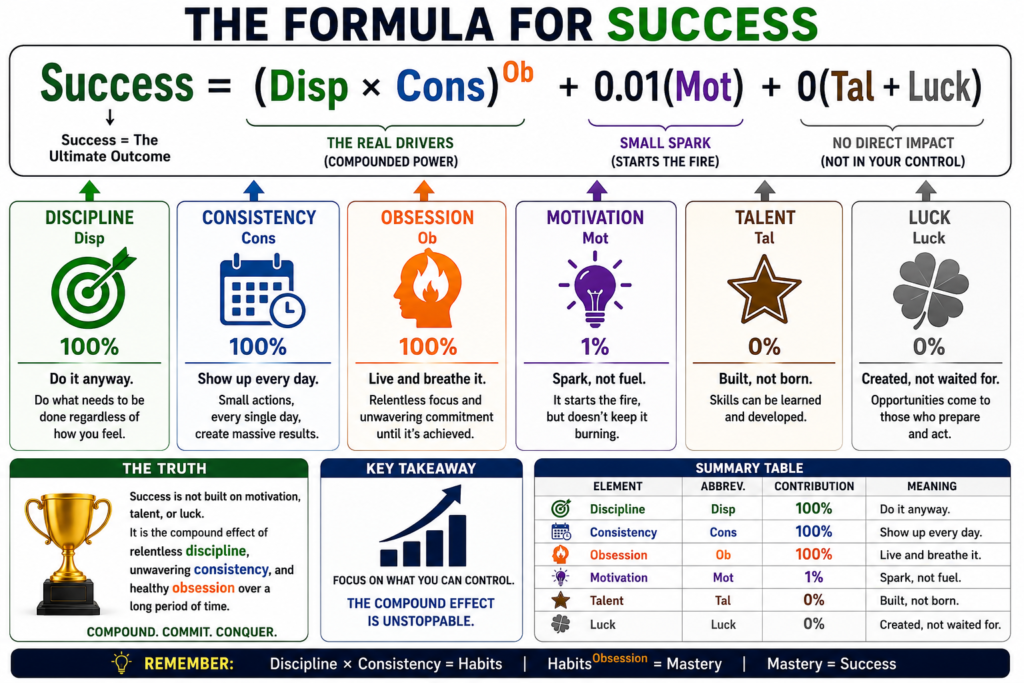
The relationship can be written compactly as an exponential expression, where discipline and consistency multiply each other, and obsession raises the result exponentially, while motivation contributes only a marginal boost and talent and luck drop out entirely:
SUCCESS = (100% Discipline × 100% Consistency)100% Obsession + 1% (Motivation) + 0% (Talent) + 0% (Luck)
Breaking Down the Terms
- Discipline (100%) — doing what needs to be done regardless of how you feel in the moment.
- Consistency (100%) — showing up every day; small repeated actions compound into large results.
- Obsession (100%) — relentless focus that raises the effect of discipline and consistency exponentially rather than additively.
- Motivation (1%) — useful as a spark to get started, but it fades and can’t be relied on to sustain effort.
- Talent (0%) — a skill that’s built through repetition, not a fixed trait someone is born with.
- Luck (0%) — a byproduct of consistent preparation and action, not something to wait around for.
Key Takeaway
Focus only on the variables you can control. Because discipline and consistency compound each other and obsession applies as an exponent, small daily improvements produce outsized long-term results — this is the core idea behind the “301%” framing.
📊 301% FORMULA
| Element | Contribution | Meaning |
|---|---|---|
| ⚡ Discipline | 100% | Do it anyway. |
| 🔄 Consistency | 100% | Show up every day. |
| 🔥 Obsession | 100% | Live and breathe it. |
| 💡 Motivation | 1% | A spark, not the fuel. |
| 🧠 Talent | 0% | Built, not born. |
| 🎲 Luck | 0% | Created, not waited for. |
From Habits to Mastery
Discipline multiplied by consistency produces habits. Habits, sustained under obsession, produce mastery. Mastery, applied over time, produces success. Each stage depends entirely on the one before it — no shortcut skips the compounding.
Why This Matters
Treating success as a compounding function rather than a lucky event changes what you optimise for day to day. Instead of chasing motivation or waiting for the right break, the formula points to a repeatable process: show up, do the work, stay obsessed with the outcome, and let the exponent do the rest.